
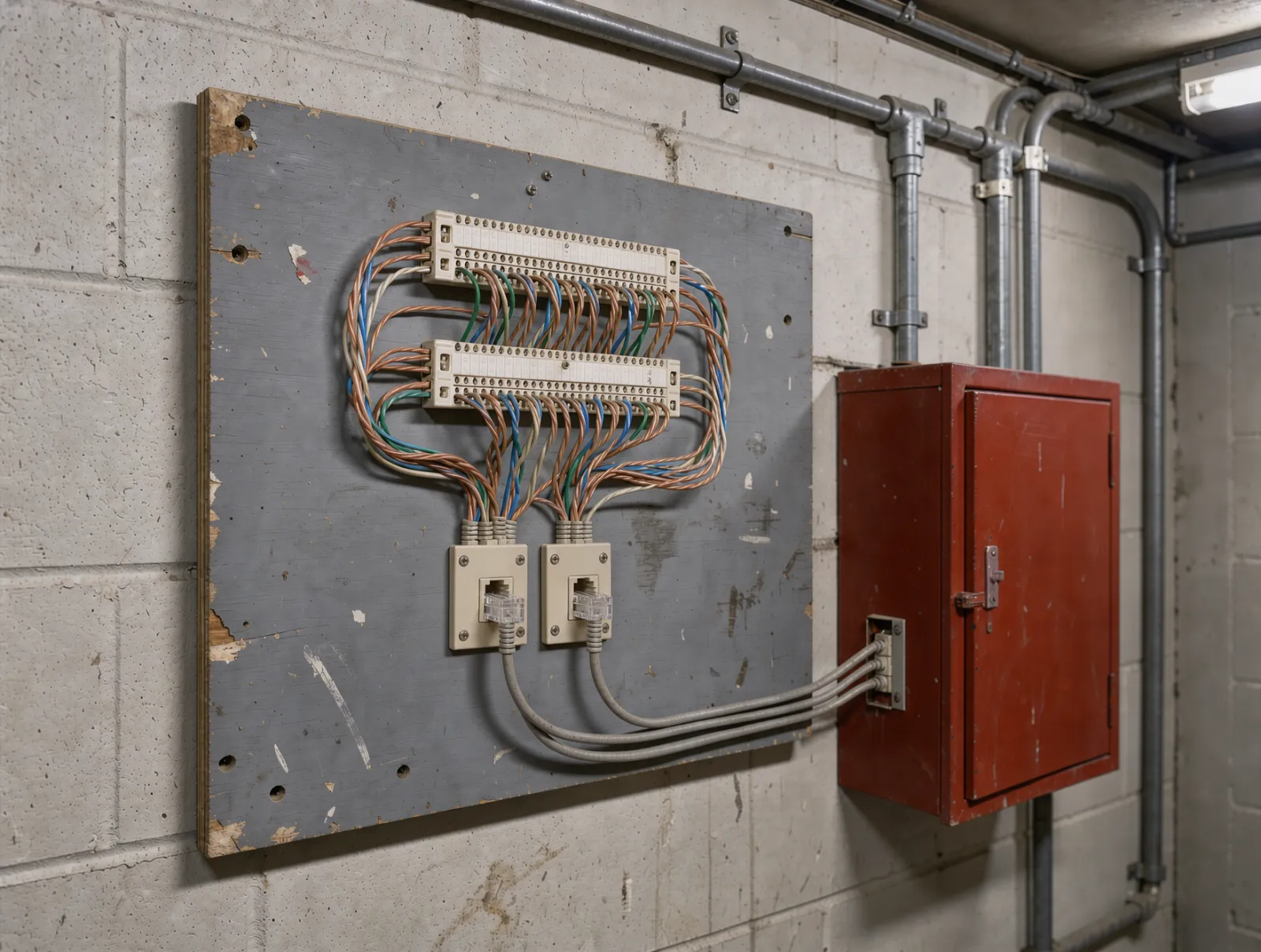
Where POTS lines are in a building.
The systems that still depend on POTS lines, from Verizon's list and our own, with the life-safety lines first.
| Line | Where to look | Why it can't go quiet |
|---|---|---|
| Fire alarm panel | Cords from the panel's dialer to jacks on the phone board, often two. | It reports alarms and test signals to a monitoring center. What a fire alarm line needs. |
| Elevator emergency phones | The elevator machine room: a line per car, or one line shared by several. | A trapped passenger has to reach a person. What an elevator line needs. |
| Burglar or security alarm | A cord from the alarm panel to a phone jack. | It reports break-ins to its monitoring center. |
| Call boxes | Gate, pool, parking and blue-light call boxes. | Each one dials a set number when someone presses the button. |
| Fax, card readers, meters | Fax machines, some credit card processors and meter readers. | Nothing life-safety depends on them, but you still pay for the line. |
POTS, VoIP or our unit?
What changes when a POTS line moves to the carrier's fiber or VoIP service, or to our unit.
| Question | Copper POTS line | Carrier's fiber or VoIP line | POTS Replacement Device |
|---|---|---|---|
| In a power outage | Gets its power from the phone company, so it usually keeps working | Usually needs a battery at your end, the FCC says | Runs on its own battery, rated for up to 24 hours |
| Ways out of the building | One copper line | One connection | Three: building internet, then cellular on two networks |
| Alarm and elevator lines | The line they use now | Check with your alarm company and monitoring center first | Up to eight lines on one unit, UL 864 listed for fire alarm signaling; a licensed alarm company connects each panel |
Five questions about POTS lines.
Pick an answer to see why. The answers come from the same sources as this page.
Questions about POTS lines.
Sources read . Call (385) 581-3080 if your question isn't here.
What does POTS stand for?
Plain old telephone service: the analog phone line a carrier runs over copper wire. NFPA 72, the fire alarm code, uses the same name for traditional copper wire telephone service.
Is a POTS line the same as a landline?
A landline used to mean a copper POTS line. Today a landline from the phone company may run over fiber or cable instead, and the FCC says those usually need a battery to work in a power outage, where copper usually doesn't.
Why are POTS lines going away?
In March 2026 the FCC adopted rules that make copper easier for carriers to retire (FCC 26-19), and AT&T and Verizon send business customers a letter with a date to move each line by. What to do with the letter.
Can a fire alarm use something other than a POTS line?
Yes. NFPA 72's annex allows equipment that emulates a phone line and sends the signal over IP, as part of a managed facilities-based voice network. Your fire department accepts the installation. Fire alarm lines after copper.
How do I find the POTS lines in my building?
Start with the phone bill and any copper letter, then match each number to a jack on the phone board and to what its cord runs. Your alarm company and elevator company can tell you which lines their equipment uses. The free line audit does the matching for you.
Sources, each read November 21, 2026
- Verizon Business, a guide to replacing your POTS linePublished Nov 25, 2025
- NFPA 72, 2025 edition, annex A.3.3.172 and 26.6.4.2.5Public copy
- FCC, Tech Transitions consumer guideLast reviewed Sep 22, 2025
- ADA Standards, Advisory 105.2.22010 Standards
Find your POTS lines.
Tick what you know still runs on copper. Cameron Hoffman, the founder, replies the same business day, matches every number on your phone bill to what it runs, and tells you what moving each line costs. The audit is free.
Or call (385) 581-3080 and leave a message.